





Fiona Harper
Pacific tourism pivots with purpose at SPTE 2026
South Pacific Tourism Organistion forum showcases how the Pacific region is rewriting the tourism playbook in a challenging global market.

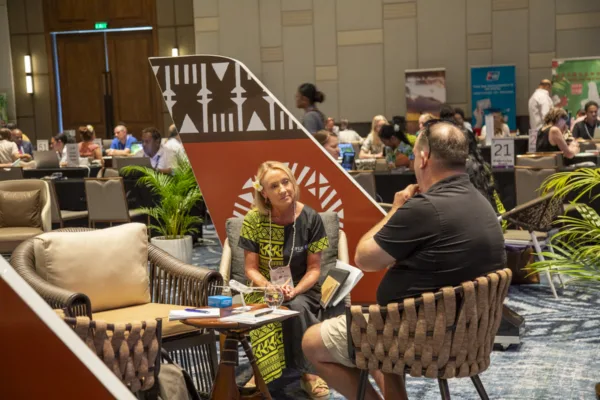


The South Pacific Tourism Exchange (SPTE) 2026 brought together the tourism industry’s movers and shakers in Nadi for one of the region’s most important annual events.
The two-day event was held at the Crowne Convention Centre in Nadi, which opened last November, with buyers, sellers and media attending from 30 countries. It’s clear that the Pacific region is entering a new era of tourism defined by purpose, partnerships and long-term resilience. It’s no secret that tourism globally has suffered many challenges in recent years. The region, with its convenient connections for Australian and New Zealand travellers, is well positioned to take advantage of global unrest.
SPTE 2026 unfolded against a backdrop of global recovery and mounting climate pressure as the event staked a claim with a bold vision for the region’s future.
SPTE 2026 is more than a tourism industry marketplace
Long regarded as the Pacific’s premier travel trade event, SPTE 2026 once again proved its value as a high-impact business platform. Government leaders, industry stakeholders and international buyers converged with a shared understanding that tourism is about growth through shared partnerships.
Deputy Prime Minister and Minister for Tourism and Civil Aviation (DPM), Mr Viliame Gavoka, reinforced the event’s strategic importance, describing it as ‘a platform that has become essential for connecting our region with the world.’
‘Sustainability and climate leadership remain at the heart of our approach,’ Deputy DPM Gavoka said. ‘Pacific tourism is already responding directly to the realities of climate change, and we are committed to ensuring that tourism contributes to solutions rather than challenges.’
In practical terms, SPTE 2026 continues to compress months of business development into two days. The event helps facilitate partnerships which strengthens global connections critical to the region’s recovery and growth trajectory.
Tourism is an economic backbone for the Pacific region
A consistent message was the undeniable economic weight of tourism across the Pacific region. With some island nations relying on the tourism sector for more than 20 per cent of GDP, the stakes are high.
DPM Gavoka highlighted the region’s growth potential, noting that projections from a 2024 World Travel and Tourism Council report indicated tourism could inject an additional US$112 billion into Oceania’s economy over the next decade.
The success of future growth hinges on stronger alignment across aviation, policy and investment – significant areas which are being prioritised at both national and regional levels.
‘Strengthening access to global markets, as well as improving intra-Pacific connectivity remains a priority, particularly in the context of ongoing global challenges,” DPM Gavoka said.
Transitioning from sun, sea and sand to tourism with soul
Beyond the economic narrative, SPTE 2026 leaned heavily into the Pacific’s unique cultural depth. Keynote speaker Peter Semone captured this shift succinctly, describing the region as offering soulfulness to the often-touted sun, sea and sand of the region.
‘Visiting the Pacific offers an invitation to connect, as the beginning of a relationship,’ Mr Smone said. He felt that connection deeply while visiting ‘Mailaita in the Solomon Islands.
‘I watched local women hand crafting shell money, breaking, smoothing and polishing each tiny disk by hand. That experience taught me the true DNA of Pacific tourism. It is that rare, world-class combination of pristine, isolated natural environments and deep, authentic cultural immersion.’
This positioning reflects a broader evolution in how Pacific tourism is being marketed and measured. Increasingly, success is tied not just to visitor numbers, but to community wellbeing, cultural preservation and authentic experiences.
The concept of meaningful tourism which gives back, continues to gain traction, signalling a move away from volume-driven strategies towards shared value for both visitors and local communities.
Sustainability takes centre stage
If there was one defining announcement at SPTE 2026, it was the launch of the ‘This for That’ campaign which seeks to eliminate single-use plastics from the tourism sector across the region.
This initiative provides a practical roadmap for operators to transition to reusable and sustainable alternatives, backed by toolkits and a long-term certification framework.
SPTO CEO Christopher Cocker framed the campaign as both an environmental and economic imperative, noting that ‘the ‘This for That’ campaign is a call to action for all of us to take responsibility and make conscious choices… we are choosing a more resilient and prosperous future for our Pacific nations.’
The initiative sets an ambitious target of 100 per cent reduction in single-use plastics from procurement baselines by 2035, aiming to position the Pacific as a global leader in sustainable tourism transformation.
Can they do it? We at Travel Boating Lifestyle, and the communities which are dependent on sustainable practices for their livelihoods, hope so.
Airline connections to remote regions remains critical
While sustainability dominated conversations connectivity remained a central concern. Aviation and its essential connectivity to remote regions is considered the ‘umbilical cord’ of Pacific tourism and continues to underpin growth ambitions.
Improving both international access and intra-Pacific links is essential to unlocking new markets and strengthening regional integration. Industry leaders emphasised that without coordinated aviation strategies, broader tourism goals will remain out of reach.
This aligns with a growing recognition that tourism development must be supported by equally robust infrastructure and policy frameworks.
Collaboration over competition
A notable shift in tone at SPTE 2026 was the emphasis on collective strength. Rather than competing as individual destinations, Pacific nations are increasingly positioning themselves as a unified region with diverse tourism products.
DPM Gavoka underscored this perspective, highlighting that the Pacific should not be seen as ‘small isolated markets, but one of collective strength, diversity and opportunity.’
This regional mindset is critical in a global landscape where scale, connectivity and brand clarity are key competitive advantages.
Resilience in a changing world
The integration of crisis management into growth strategies was another key theme. From climate change to global economic volatility, Pacific tourism faces unique vulnerabilities, but so too opportunities to lead.
Resilience is not a reactive measure but a proactive strategy, embedded in everything from sustainability initiatives to market diversification.
SPTE 2026 reflects this by delivering a single-use plastic-free event to reinforce the region’s commitment to aligning operations with values.
Looking ahead for Pacific tourism
As SPTE 2026 wrapped up it was evident that the Pacific is not simply reopening to broader markets, it is repositioning itself as a global tourism leader.
With a sharpened focus on sustainability, cultural authenticity and regional collaboration, SPTE 2026 laid the groundwork for a more resilient and competitive tourism future.
For Australian agents and wholesalers, the takeaway is equally compelling. The Pacific offering is evolving and those who understand this revitalised direction stand to benefit most. In a crowded global tourism market, the Pacific’s greatest strength may well be its ability to stay true to its identity while adapting to the demands of a changing world.
Fiona Harper travelled as a guest of SPTE 2026.
More like this...
- When does a hostel become a hotel?
- I spent the weekend at a luxe Airport Hotel
- Sleeping with rock star royalty at the Dorchester
